Project
MICIC – Migrants In Countries In Crisis
Status: Completed
Date: January 2015 to December 2019



Project
Status: Completed
Date: January 2015 to December 2019
The Migrants in Countries in Crisis project aims to provide accessible, methodologically robust, and policy-relevant data on the migration implications of crisis situations in host countries. It does so with the broader objective of informing efforts to strengthen the preparedness of countries of origin, transit, and destination, as well as other relevant actors, to address and respond to future crises.
Research objectives:
Crisis situations investigated include natural disasters, violent conflict or civil unrest, which have led to a breakdown of or serious challenges to public order, and, as a result, entail a serious threat to the personal safety, physical and psychological integrity and protection of migrants. While focusing on longer-term impacts of and responses to crises in countries of destination, origin and transit, the research will also investigate the availability of relevant mechanisms ensuring the protection of migrants before, during and after crisis in countries covered by the research. Six crisis situations have been selected as case studies for in-depth research:
The research is conducted as part of a wider project led by ICMPD supporting the global Migrants in Countries of Crisis Initiative. It is coordinated by the International Centre for Migration Policy Development (ICMPD) and is conducted in partnership with the International Migration Institute (IMI) of Oxford University. In addition, local research partners are involved in the fieldwork and analysis for the case studies.
The Research employs an interdisciplinary approach to assess the impact of crises on migrants in the countries under study. The research will combine secondary desk research and primary research in the field with relevant stakeholders, including migrants, policy makers and public officials, representatives of international organisations, civil society stakeholders and humanitarian organisations, diaspora organisations, academics and journalists, and employers and recruitment agencies.
For more information, please visit the websites of the ICMPD MICIC project and the global MICIC initiative.
Hendow, Maegan (2018): When Disaster Strikes: Responding to Migrants Caught in Crises. Migration Information Source, Migration Policy Institute. Online here.
Dina Mansour-Ille & Maegan Hendow (2018): From Exclusion to Resistance: Migrant Domestic Workers and the Evolution of Agency in Lebanon, Journal of Immigrant & Refugee Studies. Link
Video of Lunchtime Conference on 27 November 2017 at the External Cooperation Info Point with an introduction by Mr. Stefano Signore, Head of Unit DEVCO B3 and presentations by Albert Kraler, ICMPD Research Coordinator and Aurelie Sgro, ICMPD Project Manager. Video available here
Jonathan Crush, Godfrey Tawodzera, Abel Chikanda & Daniel Tevera (2017). The Owners of Xenophobia: Zimbabwean Informal Enterprise and Xenophobic Violence in South Africa. African Human Mobility Review 3(2), online here.
Alessandra Bravi and Katharina Schaur (2017): Migrants in the 2011 Floods in Thailand: Improving Migrants’ Access to Emergency and Rescue Services. In: Lorenzo Guadagno, Mechthilde Fuhrer and John Twigg (eds): Migrants in Disaster Risk Reduction. Practices for Inclusion. Geneva: International Organization for Migration. Strasbourg: Council of Europe, online here pp.71-74.
Maegan Hendow and Dinah Mansour-Ille, with Sally Youssef (2017): Engaging Migrant Domestic Workers in an Emergency: The Case of Lebanon. In: Lorenzo Guadagno, Mechthilde Fuhrer and John Twigg (eds): Migrants in Disaster Risk Reduction. Practices for Inclusion. Geneva: International Organization for Migration. Strassbourg: Council of Europe, online here pp.57-57.
Migrants in Countries in Crisis Initiative (2016): Guidelines to Protect Migrants in Countries Experiencing Conflict or Natural Disaster. Geneva: MICIC Secretariat, online here.
#crisis
European Commission (DG DEVCO)
International Migration Institute (IMI)

Long-Term Socio-Economic Implications of ‘Crisis-Induced’ Return Migration on Countries of Origin.
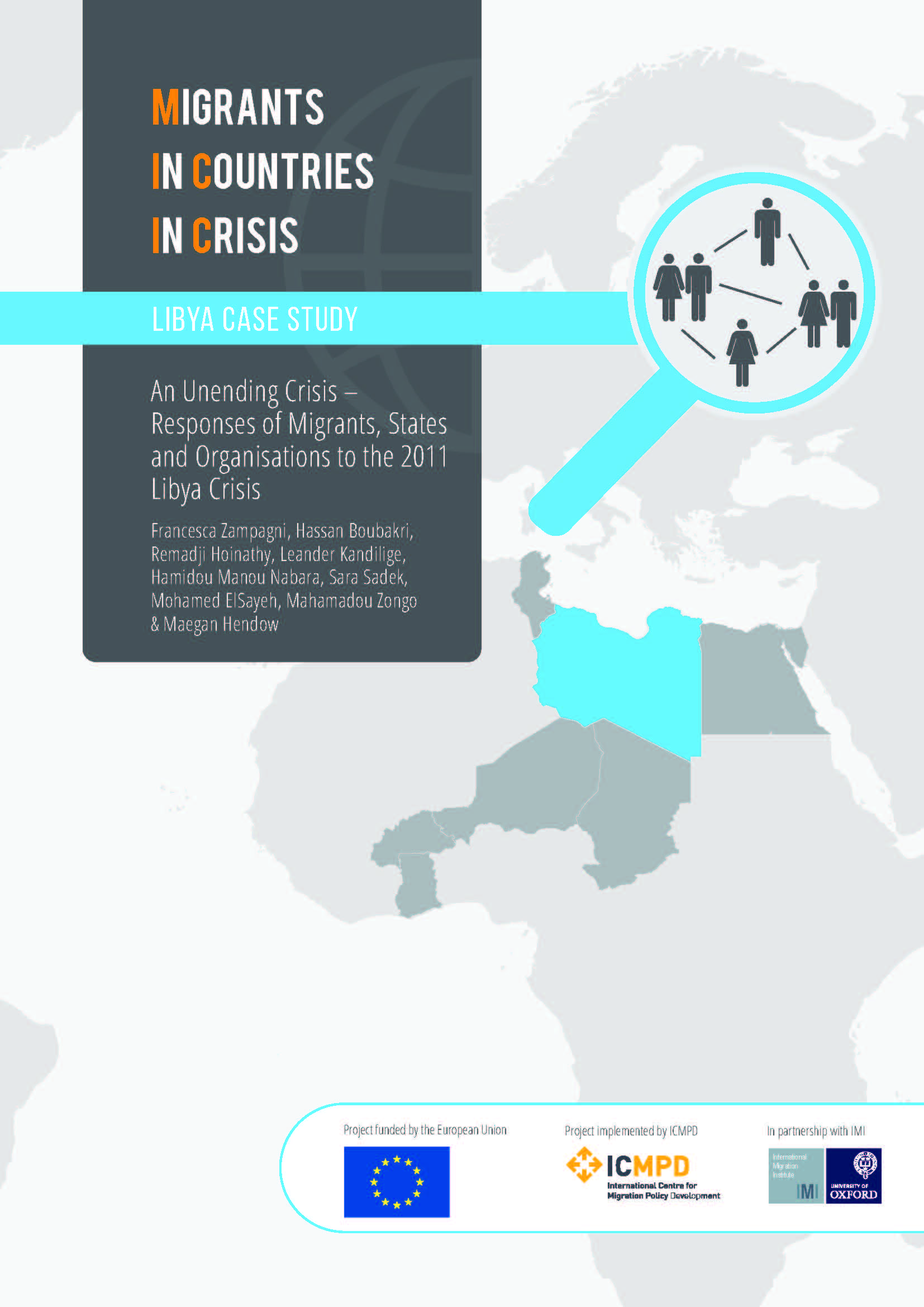
Libya Case Study: An Unending Crisis – Responses of Migrants, States and Organisations to the 2011 Libya Crisis

Migration and Natural Disasters – The Impact on Migrants of the 2011 Floods in Thailand

Lebanon: Migrant Domestic Workers and the 2006 Crisis
More from ICMPD Research under similar criteria
Migration policies addressing irregularity: a typology of responses

Manual for Early Identification of Potential Victims of Trafficking in Human Beings, Child Sexual Abuse and Child Sexual Exploitation
Factsheet PARIM II
Voices of Return: Leveraging the Influence of Returnees in Migration Information Campaigns

HEROES – Novel Strategies to Fight Child Sexual Abuse and Human Trafficking Crimes and Protect their Victims

TRAFIG – Transnational Figurations of Displacement

Evaluation of the Common European Asylum System under Pressure and Recommendations for Further Development (CEASEVAL)

Complementary Pathways for Adult Refugees: the Role of VET, Skills and Qualifications (REF-VET)